
Users can ask a question in natural language and receive an answer based on company data, such as a summary, table, visualization, or more detailed analysis.
The real innovation is not simply the use of a language model. It changes how people interact with data: instead of following a predefined analytical path, they can explore information through a conversation that adapts to the question at hand.
What is Generative BI?
Traditional Business Intelligence organizes data, KPIs, dashboards, and reports to help companies monitor performance and make informed decisions.
Generative BI introduces a more flexible way to interact with that information. Users can describe what they want to understand in their own words and continue the analysis by asking follow-up questions.
For example:
- Which customers have reduced their orders compared with the same period last year?
- Which products are driving the change in margin?
- Summarize the most significant operational anomalies from this week
- Compare performance by region and highlight the main variances
IBM defines generative BI as the application of generative AI to Business Intelligence activities, helping simplify tasks such as identifying patterns and creating data visualizations.
However, the key requirement is that AI must operate on well-governed business data, clearly defined metrics, and information that users can understand and verify.
How Is Generative BI Different from Traditional BI?
The difference can be understood through four key changes.
1. Questions Can Arise After the Dashboard
Reports and dashboards work well for recurring monitoring needs. Generative BI becomes valuable when an unexpected question emerges, such as a sudden decline, an unusual variance, or the need for a new comparison. Instead of waiting for a new report to be created, users can investigate the issue directly.
2. The Analysis Can Continue Through Follow-Up Questions
An initial answer may lead to further questions: “Which region is most affected?”, “When did the change begin?”, “Which customers contributed the most?” Because the system retains the context of the conversation, users can narrow down the analysis without having to rebuild the query or analytical process from scratch.
3. The Output Is Not Limited to a Single Chart
A response may take different forms depending on the question: a written summary; a list of contributing factors; a table; a time series; a data visualization. The format should be selected according to the analytical need, rather than generated automatically simply for visual impact.
4. The Role of the Data Team Evolves
When repetitive requests decrease, the data team can focus more attention on higher-value activities: Improving data quality; defining consistent business metrics; developing the semantic layer; managing permissions; validating the accuracy of answers. Generative BI does not eliminate the need for data expertise. It shifts that expertise toward governance, quality, and enablement.
Generative BI, AI Dashboards, and SQL-Free Queries: what is the difference?
These concepts are closely related, but they are not interchangeable.
- Generative BI is the broadest category and refers to the use of generative AI for analyzing business data
- AI dashboards are visual interfaces where KPIs and analytics are enhanced with intelligent features
- SQL-free queries describe an operational capability that allows users to query a database without manually writing SQL code
A platform may support natural-language queries without providing a complete Generative BI environment. Similarly, a dashboard may include anomaly detection or forecasting capabilities without allowing users to explore their data through a conversation.
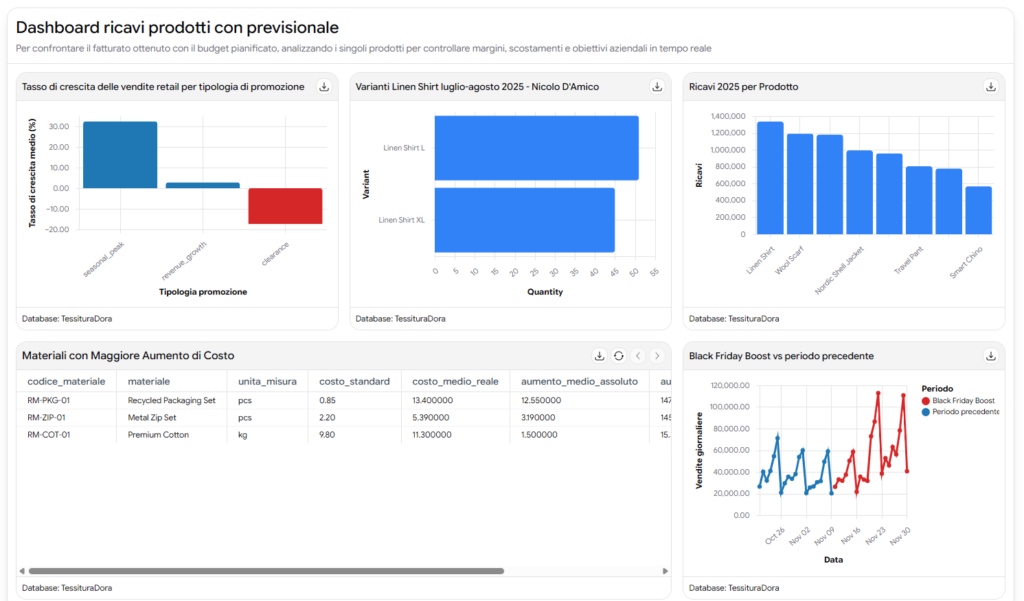
Where does generative BI deliver value?
Generative BI is particularly useful when there is a significant gap between the questions business users need to answer and the time required to produce a new analysis.
Investigating Anomalies: a KPI highlights a potential issue. The user can explore its underlying components, compare periods or segments, and identify where further investigation is needed.
Preparing for meetings and decisions: executives and managers can quickly build a concise overview of business performance, provided that the information is traceable and connected to official company metrics.
Guided Self-Service Analytics: business teams can answer recurring questions independently, without turning every request into a new ticket for the IT or BI team.
Creating ad hoc views: an occasional question can generate a useful table or chart without requiring the development of a permanent dashboard.
What needs to be in place before AI?
A conversational interface cannot fix a disorganized data environment. Before adopting Generative BI, companies should assess whether five essential conditions are in place.
- Reliable data: Data sources must be current, consistent, and correctly connected. When two systems represent the same customer differently, the resulting answer may sound credible while still being operationally incorrect
- Shared metrics: Revenue, margin, active customers, and qualified leads must have clear and agreed definitions. A semantic layer helps connect business terminology with the underlying data structure
- Business context: the platform must understand the organization’s terminology, hierarchies, and relationships. A technical database schema alone is rarely sufficient
- Consistent access controls: every question and answer must respect user roles and permissions. Ease of use must not result in unrestricted access to sensitive information
- Verifiability: Users must be able to understand which data sources, filters, and assumptions support an answer, especially when the analysis informs financial or operational decisions
When should a company consider generative BI?
Generative BI is worth testing when:
- the company already has usable data and consistently defined KPIs
- existing dashboards support monitoring but cannot answer every follow-up question
- the BI team receives a high volume of similar or relatively simple requests
- managers struggle to use the company’s current analytics tools
- the organization wants to extend self-service analytics to more employees
- the organization wants to extend self-service analytics to more employees
Generative BI should not be the first priority when data sources are fragmented, metric definitions vary between departments, or no one is responsible for data governance. In those situations, the company should first focus on building reliable data foundations.
How to set up a generative BI pilot
An effective pilot should not begin with the question, “What can AI do?” It should begin with a specific business decision or analytical need.
- Select a business process: Choose sales, finance, operations, or another area where users regularly ask data-related questions
- Limit the data sources: start with a clearly defined scope and data that has already been reviewed and validated
- Collect real business questions: use questions that managers and operational teams already ask during their day-to-day work
- Define quality criteria: assess answer accuracy, clarity, time saved, and the system’s ability to support deeper analysis
- Involve both business and data teams: validation cannot be exclusively technical or exclusively business-driven
- Measure adoption: determine whether employees use the answers in practice and whether the volume of manual analysis requests decreases
The role of DataTalk
DataTalk is an AI-driven Business Intelligence platform designed to connect business questions with company data. It combines natural-language queries, data insights, and interactive visualizations while keeping governance at the center of the analytical experience. The most effective evaluation starts with real data and real business questions. This makes it possible to understand whether Generative BI can reduce the time between analysis and decision-making within a company’s specific operational context.
When a team has access to data but still depends on manually produced reports for every new question, testing DataTalk on a real use case can help clarify the potential value of Generative BI.
FAQ
No. Generative BI complements dashboards and reports by providing a more flexible way to investigate questions that were not anticipated when the original reports were created. Recurring dashboards remain essential for monitoring and performance control.
Business users can ask questions without writing SQL. Technical expertise is still required to manage data sources, models, security, permissions, and answer validation.
Its reliability depends on the quality of the underlying data, the business context provided to the system, and the controls in place. Answers should always be verifiable. They should not be treated as accurate simply because they are presented in a clear and convincing way.
Yes, provided that the company has usable data, recurring analytical questions, and a clearly defined initial use case. Data maturity is more important than company size.