
Artificial intelligence has now firmly established itself as a priority for businesses. Gartner forecasts that global spending on AI will reach $2.52 trillion in 2026, representing a 44% increase on the previous year. At the same time, McKinsey notes that many organisations have not yet integrated AI deeply enough into their workflows and processes to achieve tangible benefits at an enterprise level. This is the paradox we must start from: investment is growing much faster than the value actually realised.
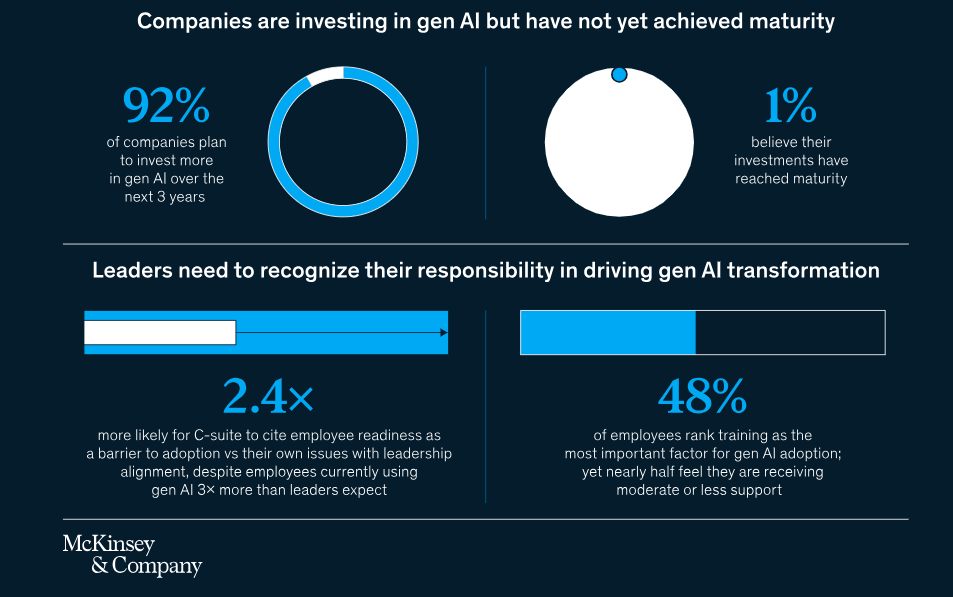
The Superagency in the Workplace report, on the other hand, highlights that almost all companies are investing in AI, but only 1% consider themselves to have truly reached maturity in its adoption. This suggests that the use of AI is now widespread, but its transformation into structural impact remains limited.
In business intelligence, this translates into a very recognisable pattern. AI is used to speed up existing work: generating insights more quickly, summarising data, automating queries, and reducing the time needed to produce dashboards or analyse historical trends. All of this is useful, as it reduces friction and operational lead times. However, increased speed does not automatically equate to better decision-making.
The point, in fact, is not merely to act faster, but to enable people to understand things sooner and more effectively. If AI is confined to improving internal efficiency, its value tends to be incremental. If, on the other hand, it makes data more accessible and understandable to those who need to take action, then it can begin to have a broader impact on the business.
Competitive advantage stems from access to data, not just from automation
This is the key point for a truly insightful understanding of AI-driven business intelligence.
Competitive advantage does not stem solely from the ability to do what already exists more quickly, but from the fact that decision-makers can analyse data rapidly, clearly and without technical complexity. It is this shift that transforms AI from a driver of productivity into a driver of decision-making quality.
When access to data is easier, at least four things happen:
- the time between enquiry and response is reduced
- managers are less reliant on intermediate steps
- business departments find it easier to work from a common basis
- The decision comes with more context, not just with greater speed
This changes the way the company responds. A sales manager can spot a trend early on and adjust course. A marketing team can compare actual performance with forecast trends without having to wait for a manual re-calculation. An administrative manager can check variances and margins without having to piece together the picture from different sources every time. In all these cases, the value does not stem from the automation itself, but from the fact that the data is finally made accessible to those who need to use it.
Why direct access to data improves the quality of decisions
Many large companies and SMEs already have enough information to make better decisions. The problem is that this information is not yet available when it is actually needed, or is accessible only to those with technical expertise or specialist tools.
This is where AI-powered business intelligence can make a real leap forward. Not by adding another layer of complexity, but by lowering the barrier to accessing data. If a manager can ask a question in natural language, gain immediate insights, investigate an anomaly or test a hypothesis without unnecessary steps, the value takes on a new dimension: it is no longer just about internal efficiency, but about a greater ability to understand and act.
This is also the point at which AI ceases to be seen as a vague promise and becomes a practical tool for working more effectively. The benefit is not merely technical. It is organisational. It is decision-making. And it is also cultural, because it transforms data from an indirect resource into a directly usable one.
How to turn AI into a real competitive advantage
To truly turn AI into a competitive advantage, companies should change at least three things:
- the criteria they use to assess success: if the KPI remains solely the time saved or the number of automated tasks, AI will continue to be viewed primarily as a means of improving efficiency. It is also necessary to measure the quality of access to information, the speed of decision-making, the reduction of internal bottlenecks, and managers’ ability to act with greater autonomy.
- Use cases: the most useful projects are not just those that automate repetitive tasks, but those that bridge the gap between data and decision-making. In this sense, AI should be designed first and foremost around real-world decision-making moments: forecasts, variances, commercial performance, margins, operational priorities and the interpretation of weak signals.
- the user experience: if the data remains difficult to query, too technical or too slow to retrieve, its value remains concentrated within a few key areas of the organisation. If, on the other hand, it becomes clear and accessible to those leading departments and teams, the benefits spread throughout the organisation.
McKinsey points out that organisations that derive the most value from AI do not simply use it to improve efficiency, but also link it to growth and innovation. This is a key insight: the competitive edge is gained when AI is not confined to optimisation, but helps to transform the way the company identifies opportunities and makes decisions.
The role of conversational business intelligence
In this context, conversational business intelligence plays a particularly interesting role. It brings data closer to the people who need to use it, reducing reliance on technical jargon, manual queries or constant intermediaries.
This does not mean simplifying things in a superficial way, but rather making complexity manageable. It means giving a manager the opportunity to ask a clear question, receive a comprehensible answer, explore a trend and reach a well-informed decision more quickly.
Here, the value for the company is very tangible:
- less waiting time to gain insights
- less fragmentation across departments and teams
- greater autonomy for department heads
- greater continuity between analysis and action
The difference between efficiency and competitive advantage
You may be wondering what the difference is between efficiency and competitive advantage. Efficiency reduces time and costs. Competitive advantage arises when data reaches decision-makers more directly, at the moment they need it, with the clarity required to take action.
That is why the key is to make better decisions.
If AI can make data more accessible, easier to understand and less dependent on technical complexities, then its impact changes. It is no longer merely an operational improvement. It becomes a real driver of work quality, decision-making speed and competitive advantage.
Ease of use
without technical expertise